In Pursuit of Profit
Read our expert article below or sign up to get articles sent to your inbox.

 There is no doubt the US workforce landscape continues to experience significant changes. The business challenges of the last few years have caused many companies to rethink how they can best execute their operating plans. With more and more companies outsourcing their accounting functions, there are a few important things to keep in mind to ensure a beneficial outcome.
 When your controller leaves, the logical next step is to find someone to fill the vacant position. Right?
Maybe not. Simply hiring another controller may not actually be the best decision for your business. We work with companies everyday who are looking for accounting and finance leadership roles and it is not uncommon to have clients tell us they need a controller and then listen to them define the role only to discover that what they are looking for is a different position entirely. Now, some organizations we work with are, in fact, in need of a controller. However, others have needs that better align with more senior financial leadership like that of a CFO, while others have requirements that fit better with a mid-level management accounting position. Instead of jumping right into hiring a controller, take the time to understand what kind of role will be the best fit for your company.  The last decade has ushered in a digital revolution across all business areas. However, many businesses are still dragging their feet when it comes to automating their accounting and finance activities. In fact, 58% of finance teams surveyed indicated that they do not feel their finance back office is “sufficiently automated.”
Despite a plethora of tools and platforms available to help streamline these critical business areas, it seems many businesses are stuck in the past, relying on manual processes for their daily accounting functions. But organizations can use automation to drive profitability if they understand its benefits and can identify areas where AI will help them the most.  We talk to people every day that are looking for accountants for their companies. And being in the business of staffing organizations through both full-time hires and outsourced accounting services, we have noticed a trend in people’s thinking…
Business owners and hiring managers typically categorize their hiring intentions into one of two buckets: a part-time bookkeeper/bookkeeping service or a full-time accountant hire. But many business leaders overlook the value that a part-time accountant (or “fractional accountant” as they are referred to in the industry) can provide to their organization. Whether the organization is for-profit or not-for-profit, a fractional accountant can be brought in for a variety of reasons to provide the same level of expertise of a full-time, dedicated accountant. While a fractional accountant from an accounting service provider may work on a less than full-time basis, their experience-level is as high (if not higher) than your average accountant. The reason a fractional accountant may bring a greater breadth of experience the role is because they work with a variety of companies across a different industries and lifecycles simultaneously, which requires that they be well versed in a wide variety of accounting topics and stay abreast of all the latest news. As a result, fractional accountants may offer more accounting acumen at a much lower cost than their full-time counterpart.  As an accounting recruiting firm and financial services provider, we work with businesses everyday who ask, “Should we hire or outsource our accounting needs?”
This question is especially important for companies in the startup phase because they likely have significant cash flow concerns to consider. However, startups may also have other unique characteristics that make this question more challenging to answer, such as:
While every business will have their own unique needs and challenges, it is generally best for a startup to outsource their accounting activities initially and then hire internally as their needs change. Where does that shift happen?  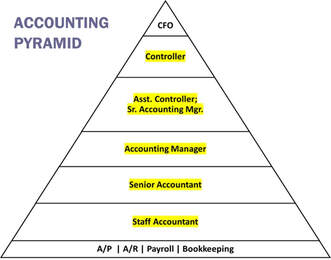 The accounting pyramid organizes accounting-related job titles into a hierarchy that ranks them by responsibilities and deliverables, with bookkeepers at the bottom, accountants in the middle, and the Chief Financial Officer (CFO) at the top.
While it is obvious to most people that bookkeepers are the most entry-level accounting team staff and CFOs are the bosses at the top, there is a lot of confusion in the middle. Understanding the difference between a Staff Accountant, Senior Accountant, and Accounting Manager, is something many business professionals (even hiring managers) do not understand. Many people assume that Staff Accountants and Senior Accountants are individual contributor roles with varying levels of experience and Accounting Managers and Senior Accounting Managers are the people who oversee teams of lower-level accountants. However, that is not a correct understanding of the stratification of roles. To further complicate matters, some people use the titles of Senior Accounting Manager and Controller interchangeably, which adds even more confusion. To provide some clarity on the topic, we will explain what each job title means, how it differs from other adjacent accounting positions, and when you need to hire each role: “Finance” is a broad term every business leader has heard, but it can mean many different things.
Businesses have banking relationships, investments they need to track, fundraising and financial analysis needs. Corporate Financial Planning and Analysis (FP&A), the work performed by Financial Analysts, is a complex specialty within Finance that all successful businesses need in some degree. There are multiple FP&A components of which every business requires a different combination. This complexity makes hiring to satisfy your FP&A needs difficult. To make matters harder, many accounting and FP&A functions can overlap. So how do you know if you need to hire a dedicated Financial Analyst or a hybrid accountant? It helps to first understand the components of Corporate FP&A, the value each adds, and how much time each activity should take. 5/25/2021 Why Can’t I Keep an Accountant? High employee turnover can be bad luck, but more often it hints at an underlying problem. That problem may be rushed hiring, a mismatch between the job description and the demands of the role, a poor fit for the role, or inadequate retention incentives.
If you are going through accountants more than every few years, it is time to ask yourself what your company can be doing differently in defining the role, finding the right candidate, supporting the new hire, and retaining an individual in the role.  The 2020 pandemic caused significant change across the business landscape. CEOs and business owners were put to the test as they decided how to strategically navigate the effects of the pandemic. As a result, many business owners have realized certain aspects of their company’s financial operations may shift indefinitely.
As the practice manager for an accounting firm, I’ve been in a unique position throughout the pandemic because I’ve witnessed our client pool expand to include companies that would never have considered using a third-party accounting company to handle their accounting needs before. However, these business owners were put in a difficult position when in-person work was shut down and some key employees had to take time off for sickness or family obligations. Some lost their accountants to virtual school responsibilities, while others were forced to upgrade their desktop accounting systems to cloud-based versions so employees could collaborate remotely. As a result, business owners have now experienced first-hand that their bookkeeping and accounting work can be performed remotely without having to sacrifice quality and efficiency. In other words, the same value can be realized whether day to day accounting is being performed remotely or onsite. Let’s look at what business owners are telling our accountants, and what this means for the future of accounting and finance.  We see a variety of circumstances in our practice at ASP, whether it be outsourced consulting needs, or an organization growing and needing to consider a fulltime resource. Our recruiting efforts are responding to those fulltime needs daily. The pandemic has shifted the business landscape significantly, making strong financial leadership universally important.
Small companies that previously had their CEO at the helm of financial operations have realized that they need a fulltime controller to oversee their accounting operations and staff. With the increased demands of operating during financially uncertain times, CEOs need to focus on their core role of running the company overall (pivoting and shifting as needed), while entrusting another professional with the financial management of the company. As a result, hiring a fulltime controller is no longer optional these days with the following business trends occurring: |
SUBSCRIBE:DOWNLOAD:
DOWNLOAD:
Categories:
All
Archives:
April 2024
|
 RSS Feed
2/22/2022