In Pursuit of Profit
Read our expert article below or sign up to get articles sent to your inbox.

 An article from our Accounting and Finance Recruiting Team
With our professional and personal lives becoming more blended than ever and younger members of the workforce feeling less of a need to compartmentalize the two, social media has become a territory ripe with both risk and opportunity. These days everyone knows that what is posted on social media is fair game, and voicing unpopular opinions, sharing inappropriate content, or being hateful online can cost a job seeker the job. And while people posting or sharing those types of things may not be concerned with how they will be perceived, most job seekers do care what a prospective employer may think of them. This is especially true in more buttoned-up industries like accounting, finance, banking, financial planning, and business consulting. Career-focused professionals looking for their next role will ask questions like:
Our accounting and finance recruiting team answers these questions regarding how your web presence affects hiring decisions:  When you think of teams that help build and sustain company culture, which teams come to mind? Human Resources? Marketing? Sales? Customer service maybe? These areas of the company are typically entrusted with developing and propagating a culture that encourages employees to do their best work, helps the organization achieve its objectives, and looks good to customers and key stakeholders.
But what about accounting and finance? These departments tend to be overlooked when a company is building its workplace culture. To understand why accounting and finance professionals get passed over when looking for a group to adopt and maintain the culture, it is important to understand what company culture is, why it is important, and how an accounting team is in a unique position to help support it.  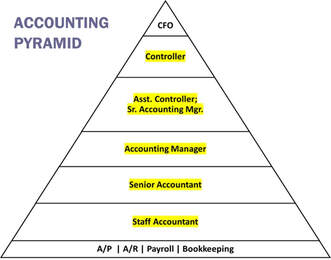 The accounting pyramid organizes accounting-related job titles into a hierarchy that ranks them by responsibilities and deliverables, with bookkeepers at the bottom, accountants in the middle, and the Chief Financial Officer (CFO) at the top.
While it is obvious to most people that bookkeepers are the most entry-level accounting team staff and CFOs are the bosses at the top, there is a lot of confusion in the middle. Understanding the difference between a Staff Accountant, Senior Accountant, and Accounting Manager, is something many business professionals (even hiring managers) do not understand. Many people assume that Staff Accountants and Senior Accountants are individual contributor roles with varying levels of experience and Accounting Managers and Senior Accounting Managers are the people who oversee teams of lower-level accountants. However, that is not a correct understanding of the stratification of roles. To further complicate matters, some people use the titles of Senior Accounting Manager and Controller interchangeably, which adds even more confusion. To provide some clarity on the topic, we will explain what each job title means, how it differs from other adjacent accounting positions, and when you need to hire each role: “Finance” is a broad term every business leader has heard, but it can mean many different things.
Businesses have banking relationships, investments they need to track, fundraising and financial analysis needs. Corporate Financial Planning and Analysis (FP&A), the work performed by Financial Analysts, is a complex specialty within Finance that all successful businesses need in some degree. There are multiple FP&A components of which every business requires a different combination. This complexity makes hiring to satisfy your FP&A needs difficult. To make matters harder, many accounting and FP&A functions can overlap. So how do you know if you need to hire a dedicated Financial Analyst or a hybrid accountant? It helps to first understand the components of Corporate FP&A, the value each adds, and how much time each activity should take. 5/25/2021 Why Can’t I Keep an Accountant? High employee turnover can be bad luck, but more often it hints at an underlying problem. That problem may be rushed hiring, a mismatch between the job description and the demands of the role, a poor fit for the role, or inadequate retention incentives.
If you are going through accountants more than every few years, it is time to ask yourself what your company can be doing differently in defining the role, finding the right candidate, supporting the new hire, and retaining an individual in the role.  Your accountant just gave notice, what do you do now?
Hopefully, your accountant gave you more than the obligatory two weeks, but regardless of what the timeframe looks like, the steps are the same:
Time is of the essence in this situation, especially if it coincides with a closing period or tax season, so you should get started immediately!  When looking to hire management-level financial roles, it is crucial to understand the current recruiting trends that will affect your ability to hire the right candidates. So, what are we seeing so far this year?
Today’s employment market is like nothing we have seen before. Accounting and finance professionals continue to be in high demand despite unemployment figures being up in other professions, but recruiting has changed significantly over the last year. Effective recruiting right now hinges on utilizing digital tools, reimagining job requirements, prioritizing career growth, providing the right employment incentives, fostering a positive workplace culture, and utilizing a professional recruiting firm 3/22/2021 How to Hire a Financial Controller How do you know if you need to hire a financial controller? A controller is essential when:
A controller can implement internal controls to mitigate financial risk, improve cash flow, and facilitate profitable growth. As a result, hiring a financial controller is a key strategic move, but it hinges on correctly defining the role and seeking out the best candidate. 3/15/2021 Do You Need a CPA? Recruiters play a unique role in the hiring process for accountants and other financial personnel. We are tasked with fulfilling a hiring manager's requirements and are also deeply in touch with the reality of the candidate market. Often there is a gap between the two that we must navigate.
In finance and accounting recruiting, one request we frequently receive is that candidates hold active CPA licenses. This requirement has come from all industries, all size companies, and all positions from staff accountants to CFOs. Understandably, most companies desire the best person for their position for various reasons – from wanting the most intelligent person to wanting someone to do their taxes to just wanting someone more trustworthy. But do you need a CPA on your accounting team? 3/3/2021 What is Contingent Recruitment? According to recent data, 76% of companies report that attracting well-qualified candidates is their biggest hiring challenge, making recruitment a serious concern for most businesses.
Hiring a recruiting firm is the best way to find top-notch candidates for your open positions. While some recruiting agencies use a retainer model, others use a contingency agreement. How do you decide which approach is best for your needs? With contingent recruitment, the recruiting agency only gets paid when they find and place a qualified candidate into the role they are hiring for on behalf of their client. Contingency recruiting fees are typically structured as a percentage of the candidate’s first-year base salary and can vary widely from one recruiting company to another based on geography, industry, and position level. Why Use Contingency Recruiting? Unlike retained search, where recruiting fees are typically paid in installments at the beginning and throughout the process, contingent recruiting is based on the idea of only paying once results have been achieved. Many companies prefer to work with a recruiting agency that uses a contingency model because it is often much less expensive, and the fees are easier to understand. It is reassuring to hiring companies, especially smaller businesses, to know that they will not be paying a recruiting fee until after a qualified candidate has been hired. |
SUBSCRIBE:DOWNLOAD:
DOWNLOAD:
Categories:
All
Archives:
April 2024
|
 RSS Feed
8/31/2021